

Mobile App Backend Development: Build for the Phone, Not Just the Server

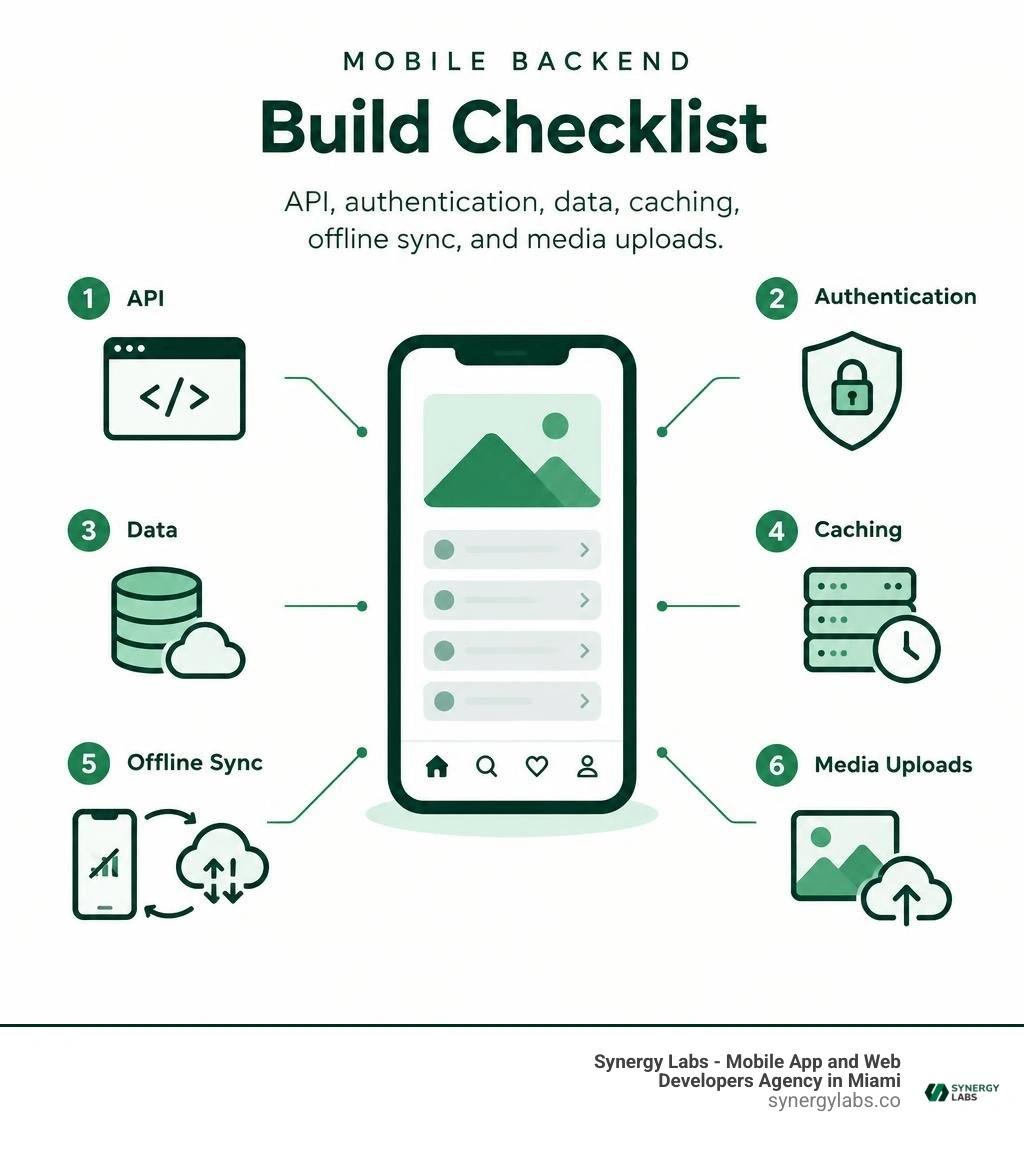
To build a mobile app backend, start with the screens your app needs to serve. Define the data each screen uses, then build an API that delivers it in as few calls as possible. Add secure sign-in, a database shaped around those requests, and caching for data users fetch often. Store changes on the device when it goes offline, then sync them when the connection returns. Send large media files straight to cloud storage rather than through your API.
In 2026, a fast server alone is not enough. Cellular delays, dropped connections, and extra requests can slow the app and drain the battery. I’m the director of product at Synergy Labs, and this guide walks through the choices that help a mobile backend stay fast, secure, and ready to grow.
Basic mobile app backend development vocab:
- mobile app tech stack
- custom mobile app design
- app development team collaboration
Core Architecture Principles for Mobile App Backend Development
Building backends for mobile applications requires a fundamental shift in perspective compared to designing for desktop web browsers. Desktop clients operate on stable broadband lines with persistent power supplies and predictable round-trip times. Mobile clients live in a chaotic world of fluctuating radio states, sudden tunnel dropouts, network handoffs between 5G, LTE, and spotty public Wi-Fi, and tight device operating system execution limits designed to preserve battery life.
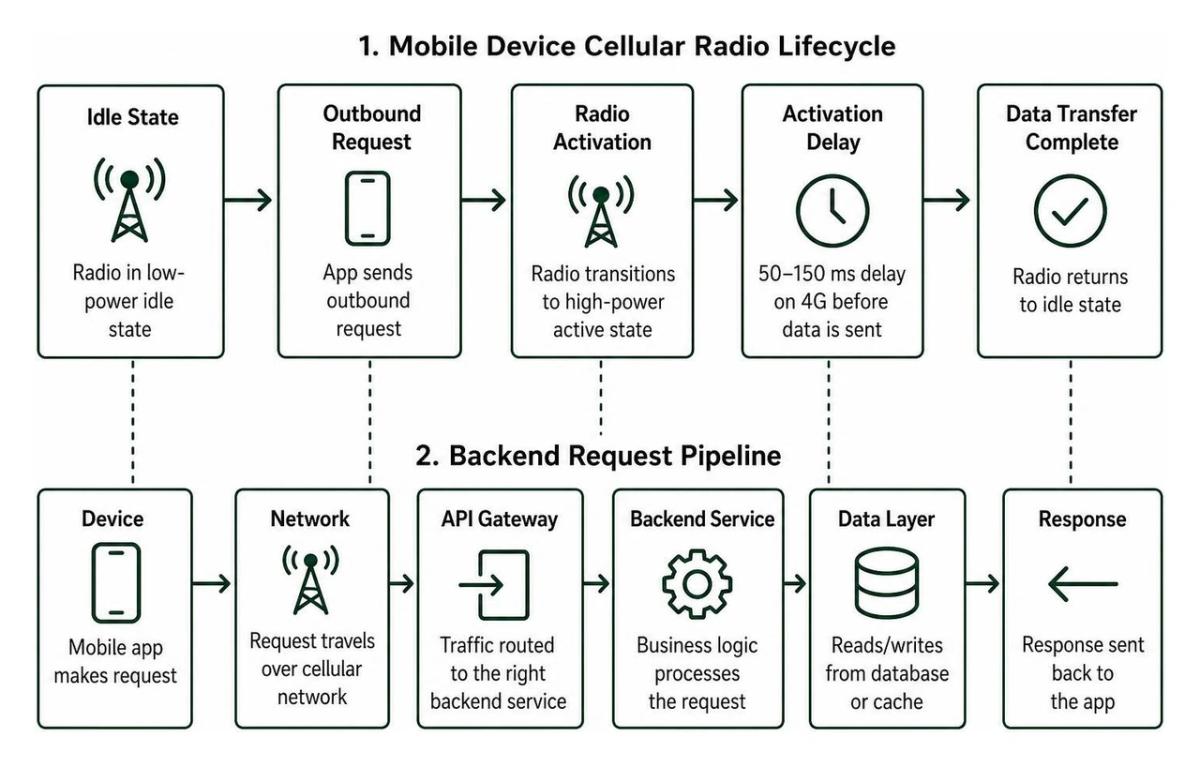
With global smartphone users reaching 7.5 billion by 2026, engineering your backend to tolerate mobile network volatility is no longer optional. When a phone communicates with a cloud server over cellular networks, every outbound request triggers the physical cellular radio to transition from an idle, low-power state to a high-power active state. This state transition introduces an immediate physical latency penalty of 50 to 150 milliseconds on standard 4G connections before a single byte of application data even hits your API gateway. If your mobile app triggers six separate HTTP requests to load a user profile, your client forces the radio into sustained high-power consumption, draining the device battery while compounding round-trip latency.
To mitigate cellular latency overhead, we design backends around payload minimization and connection consolidation. Modern cross-platform app architecture patterns rely on coarse-grained, screen-oriented endpoints that deliver everything a view requires in a single network hop. Bandwidth preservation is paramount: every field returned in a JSON response consumes physical radio time and memory on the device.
Connection state recovery must also be handled gracefully. Mobile operating systems frequently suspend background apps or tear down TCP sockets when users switch tasks. A robust backend architecture treats connection drops as normal operating conditions, using idempotent request identifiers, lightweight session resumption, and efficient compression algorithms to keep data moving without forcing users to stare at loading spinners.
Choosing the Right API Style for Mobile App Backend Development
The debate between REST and GraphQL is central to mobile architecture. Neither is universally superior; each solves distinct engineering challenges depending on data complexity and network constraints.
For simple, uniform resource access patterns, REST over HTTP APIs remains exceptionally effective. When building REST backends on AWS, we strongly advocate using Amazon API Gateway HTTP APIs (API Gateway v2) instead of legacy REST APIs (v1). HTTP API v2 delivers approximately 60% lower baseline latency and cuts costs by roughly 70%, running at $1.00 per million requests compared to $3.50 per million for v1. Combined with AWS Lambda, HTTP APIs provide a lightweight, cost-effective serverless execution layer.
However, REST introduces structural challenges for complex mobile interfaces. A mobile dashboard requiring data from user profiles, recent transactions, unread notification counts, and product recommendations often forces client applications into over-fetching unnecessary fields or under-fetching, which requires chaining multiple dependent network calls.
This is where GraphQL, specifically via AWS AppSync, shines for mobile platforms. AppSync allows mobile clients to declare exact data requirements in a single query document. The backend resolves these requests across multiple disparate data sources—such as DynamoDB tables, OpenSearch indexes, and Lambda compute functions—and returns a consolidated, tailored response. This eliminates over-fetching on constrained cellular plans and cuts client-side parsing overhead.
Furthermore, AppSync natively integrates WebSockets for real-time data subscriptions and manages offline mutation queues, which aligns directly with the official AWS serverless mobile architecture guidance.
Database Strategies and Single-Table Design in Mobile App Backend Development
Traditional relational databases (RDBMS) like MySQL and PostgreSQL model data around normalized entities connected by foreign keys. While relational normalization provides querying flexibility, executing multi-table joins across millions of concurrent mobile clients introduces variable query latency, CPU contention, and connection pooling bottlenecks.
In high-concurrency mobile backends, Amazon DynamoDB configured with a single-table design pattern offers predictable, single-digit millisecond performance regardless of database scale. Instead of creating distinct tables for Users, Orders, Products, and Comments, single-table design stores all entity types in one physical DynamoDB table using generic partition keys (PK) and sort keys (SK).
By organizing composite keys with deliberate prefixes (such as PK: USER#1234 and SK: PROFILE or SK: ORDER#2026#0987), a mobile application can retrieve a user's profile and their five most recent orders in a single, lightning-fast Query operation. Relational join latency is entirely eliminated because related items are co-located in the same physical storage partition.
To support secondary access patterns without duplicating write operations, you configure Global Secondary Indexes (GSIs). For instance, setting a GSI with PK: STATUS#PENDING and SK: TIMESTAMP allows instant retrieval of pending fulfillment queues. Implementing this data structure aligns with proven strategies for scalable database design for high-growth applications, ensuring steady-state performance even during massive global traffic surges.
High-Performance Caching, Storage, and Media Ingestion
To consistently delight mobile users, server-side data processing must occur at sub-millisecond speeds. Caching sits between the mobile network and persistent databases to shield primary data stores and accelerate data retrieval.
We implement multi-tiered caching strategies to optimize performance across the stack:
- API Gateway Response Caching: Serves cached responses in 5 to 20 milliseconds, bypassing Lambda invocation overhead (which typically runs 50 to 200 milliseconds) for semi-static data like regional catalogs or system configuration settings.
- DynamoDB Accelerator (DAX): An in-memory, write-through cache designed specifically for DynamoDB that slashes read latency from 1 to 10 milliseconds down to 100 to 300 microseconds.
- Amazon ElastiCache for Redis: An in-memory key-value data structure store used for high-velocity, dynamic state management.
Redis is particularly transformative for compute-intensive mobile features. For gaming or social applications, managing a leaderboard of 1 million users with relational database sorting causes massive query slowdowns; Redis Sorted Sets compute and return a user's exact ranking in under 1 millisecond. Similarly, mobile location-based apps running proximity searches across a 1 million-location dataset achieve sub-millisecond responses using Redis GEODIST and GEOSEARCH commands, whereas PostGIS or DynamoDB geo-lookups at equivalent scales often take 50 to 500 milliseconds.
When handling rich media such as images and high-definition video, mobile clients must never stream raw binary files through API Gateway and Lambda compute layers. Doing so consumes expensive server execution time, bloats payload sizes, and risks function timeouts on unstable cellular networks.
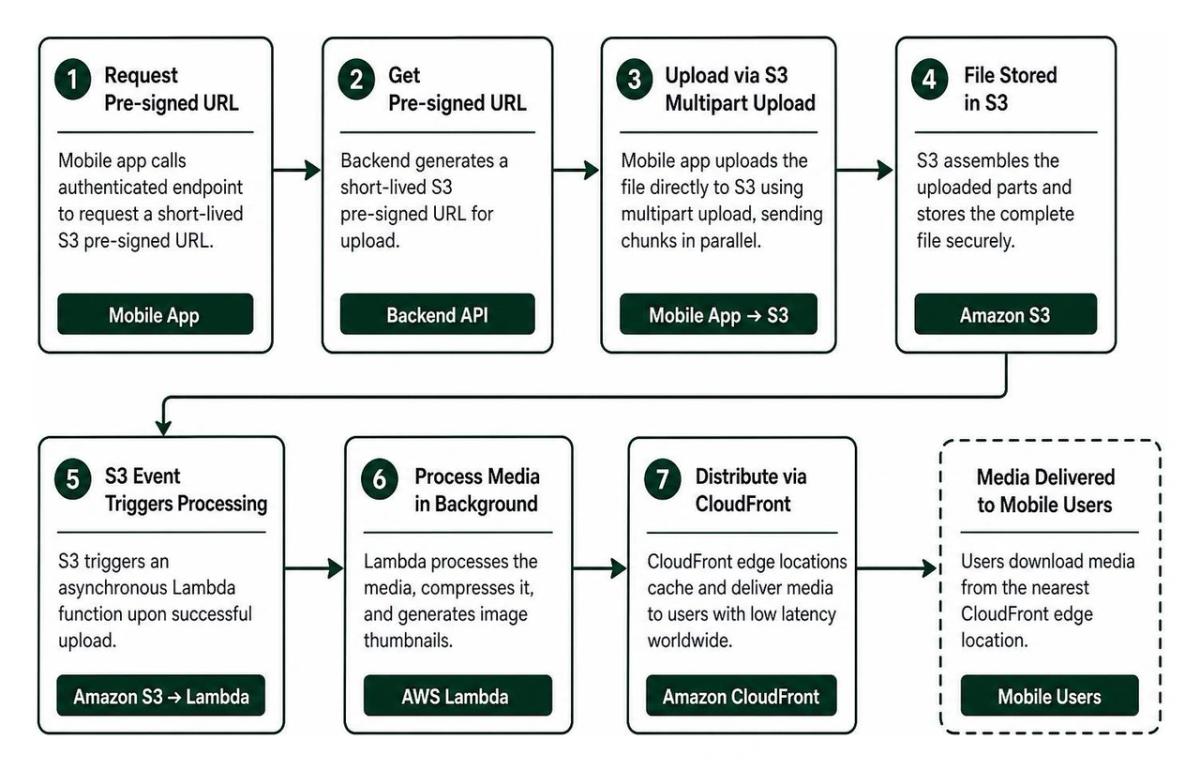
Instead, the mobile client requests a short-lived S3 pre-signed URL from an authenticated endpoint. The mobile client then uploads the binary payload directly from the device to Amazon S3 via an HTTP PUT request. For files exceeding 5MB, the client utilizes S3 Multipart Upload, splitting the file into independent chunks uploaded in parallel. If connectivity drops mid-upload, the app only re-transmits the failed chunk rather than restarting the entire file transfer.
Once uploaded, S3 triggers an asynchronous Lambda event to process, compress, and generate image thumbnails in the background. To serve media back to users worldwide, Amazon CloudFront edge routing utilizes over 450 global Points of Presence (PoPs). A user in Singapore downloading a 2MB image directly from an S3 bucket in North America experiences 250 to 400 milliseconds of latency; when served via CloudFront edge caches in their local region, that latency drops to 30 to 80 milliseconds. Integrating these performance techniques is a standard best practice in modern cloud enterprise infrastructure planning.
Mobile Authentication, Security, and Scalable Push Notifications
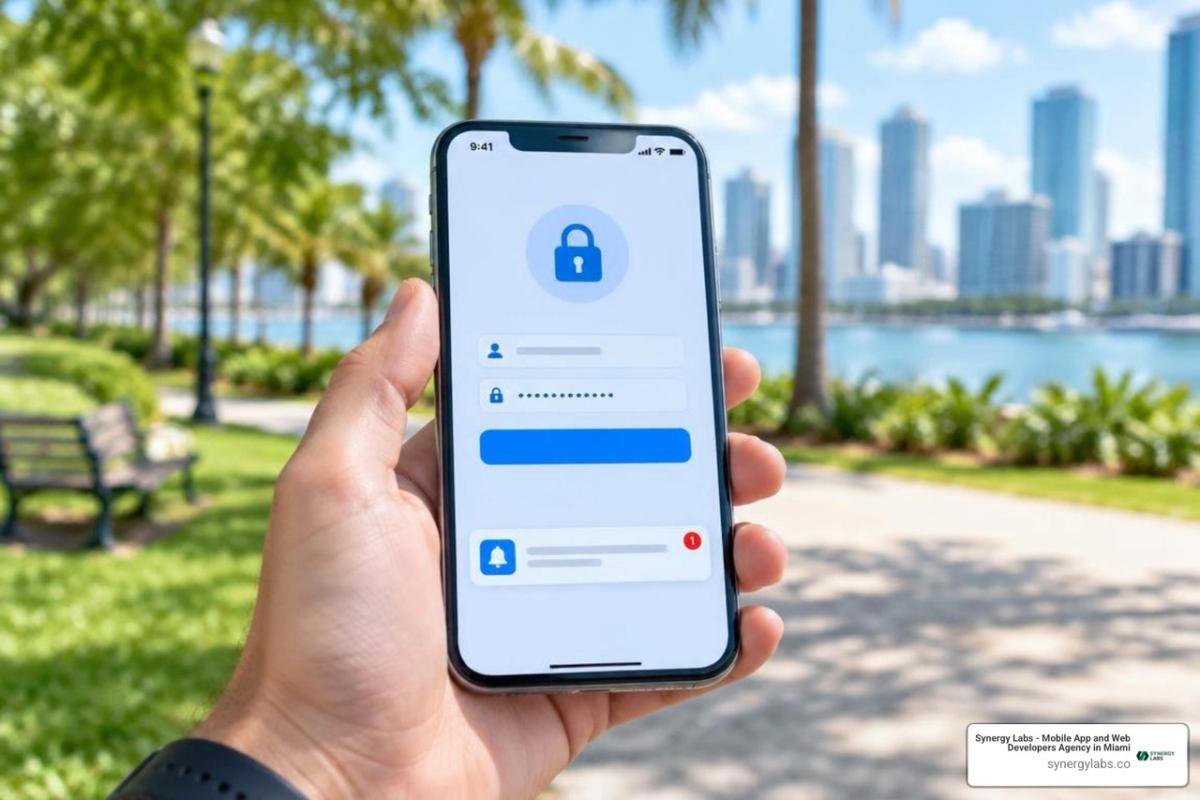
Securing a mobile backend requires architectures built for zero-trust environments. Mobile clients cannot safely store long-lived administrative secrets or static API keys because binary decompilation tools can expose embedded credentials.
The gold standard for mobile identity management is Amazon Cognito User Pools integrated with the OAuth 2.0 Authorization Code Grant flow, reinforced by Proof Key for Code Exchange (PKCE). PKCE prevents malicious apps on a shared device from intercepting authorization codes returned during authentication. Upon successful sign-in, Cognito issues three JSON Web Tokens (JWTs):
- Identity Token (ID Token): Contains user identity assertions (such as email, name, and profile data) consumed by the mobile frontend.
- Access Token: Contains authorization scopes and group memberships, validated by API Gateway or AppSync authorizers to grant API access.
- Refresh Token: A long-lived credential stored securely in the device's hardware-backed keystore (iOS Keychain or Android Keystore), used to obtain fresh access tokens without requiring the user to re-enter credentials.
To defend against compromised mobile devices, backends should implement refresh token rotation and maintain an active token revocation blocklist in Redis. Because standard JWT validation is stateless, checking a sub-millisecond Redis blocklist during sensitive operations ensures instant revocation if an account is flagged. These practices form the foundation of comprehensive mobile app security protocols.
Push notifications represent the critical outbound communication pipeline for user engagement. Mobile operating systems enforce strict platform-specific notification rails: Apple Push Notification service (APNs) for iOS and Firebase Cloud Messaging (FCM) for Android.
Managing direct connections to APNs and FCM at scale creates immense architectural complexity. Apple imposes strict rate limits of approximately 1,000 pushes per second per device connection from a single server and requires modern HTTP/2 connections with JSON Web Token signing. Furthermore, payload limits are unforgiving: APNs restricts payloads to 4KB, while FCM limits data payloads to 4KB.
To build a resilient push notification infrastructure, we route notifications through Amazon Simple Notification Service (SNS) and Amazon Pinpoint. The mobile client registers its device token (received from iOS or Android) with your backend, which registers the token as an SNS Platform Endpoint ARN stored in DynamoDB alongside the user's profile.
When an event triggers a notification, backend microservices publish messages to an SNS topic with platform-specific JSON payloads. SNS handles topic fanout, connection pooling, backoff retries, and dead-letter queues (DLQ), ensuring reliable message delivery even during massive breaking-news or marketing campaigns.
Offline-First Delta Sync and Conflict Resolution Strategies
Mobile applications must remain functional when internet access disappears. Whether a user is flying on an airplane, descending into a subway system, or experiencing rural coverage gaps, the application UI must allow reads and writes without hanging.
An offline-first architecture requires two synchronized layers: local on-device persistence (using SQLite, Realm, or local key-value stores) and a cloud-based synchronization engine. The client UI writes immediately to the local store, providing instantaneous UI feedback, while background workers queue mutations for cloud synchronization.
To keep data transfer efficient upon reconnection, the backend must avoid full-table re-downloads by implementing a Delta Sync architecture. Backends maintain a dedicated Delta Sync table that records incremental changes (inserts, updates, and deletes) stamped with monotonically increasing version numbers or server-side timestamps.
When the mobile app reconnects, it sends its last_sync_timestamp. The backend queries the Delta Sync table to return only the specific records modified since that timestamp, drastically reducing data transfer overhead, as demonstrated in the AWS AppSync offline reference architecture.
When items are deleted, the backend must not immediately purge the record. Instead, it writes a "tombstone" soft delete (setting _deleted: true). This ensures offline clients syncing later receive the deletion command and remove the item from local storage. A DynamoDB Time to Live (TTL) attribute is applied to tombstone records, automatically cleaning them up after 30 to 90 days to prevent permanent storage bloat.
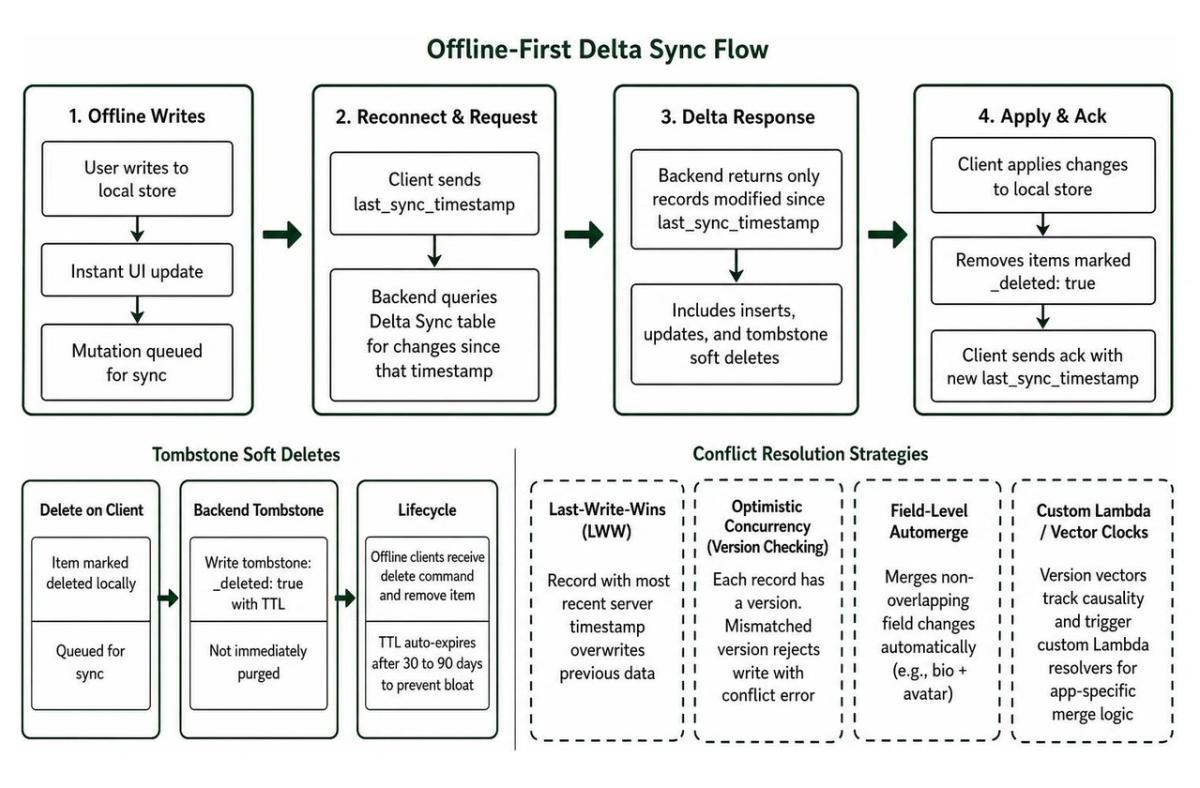
When multiple clients modify the same record concurrently while offline, the backend must execute deterministic conflict resolution:
- Last-Write-Wins (LWW): The simplest strategy, where the record with the most recent server timestamp overwrites previous data. While easy to implement, LWW risks overwriting legitimate updates made by other users milliseconds earlier.
- Optimistic Concurrency (Version Checking): Every record contains a
versioninteger. When a client submits an update, it passes the version number it based its edit upon. If the database record version has advanced past that number, the backend rejects the write with a conflict error, prompting the client to fetch the new version and re-apply edits. - Field-Level Automerge: Merges non-overlapping field changes automatically. If User A updates their profile biography and User B updates the profile avatar, the backend merges both changes into the final document without conflict.
- Custom Lambda / Vector Clocks: For complex collaborative workflows, version vectors track causality across distributed updates, triggering custom AWS Lambda conflict resolvers to apply application-specific merge logic.
Latency Engineering: Achieving Sub-200ms p99 on 4G Networks
Achieving a 99th percentile (p99) API latency below 200 milliseconds across mobile cellular networks is challenging. When 100 milliseconds are consumed by physical 4G radio round-trips alone, the backend has less than 100 milliseconds of total budget for routing, authentication, business compute, and database retrieval.
To consistently hit this performance benchmark, every layer of the backend stack must be optimized:
- Mandate Gzip and Brotli Compression: Mobile payloads must be compressed at the API Gateway layer. Standard JSON responses compress down to 20% to 30% of their original uncompressed size. Compressing a 15KB JSON response down to 3KB reduces mobile download time from 1.2 seconds to 0.3 seconds on a constrained 3G downlink (100Kbps), preventing radio channel congestion.
- Eliminate Lambda Cold Starts: Cold starts introduce 100 to 400 milliseconds of invocation delay for Node.js and Python runtimes, and up to 1 to 3 seconds for Java without optimization. To eradicate cold starts:
- Instantiate database connections, HTTP clients, and AWS SDKs outside the function handler so they persist across warm invocations.
- For Java runtimes, enable AWS Lambda SnapStart to restore pre-initialized execution environments in sub-10 milliseconds.
- Configure Provisioned Concurrency on latency-sensitive authentication and checkout endpoints to keep execution containers perpetually warm.
- Trim Response Payloads: Strip null attributes, unused metadata, and verbose timestamp strings from API responses. Smaller payloads reduce serialization time, network transit duration, and device parsing time.
- Co-Locate Compute and Data: Ensure Lambda functions, DynamoDB tables, and Redis clusters reside within the same AWS Region and Availability Zones, keeping intra-service network latency under 2 milliseconds.
Applying these engineering standards ensures enterprise-grade performance across high-traffic mobile deployments, as detailed in our analysis of enterprise mobile system optimization.
Frequently Asked Questions About Mobile App Backends
Should a mobile backend use DynamoDB or relational databases like Aurora?
The choice depends on your application's data access patterns and scaling requirements. DynamoDB is the premier choice for consumer mobile apps with well-defined, predictable access patterns, such as social feeds, e-commerce storefronts, and chat messaging. It offers virtually limitless horizontal scaling, automatic multi-AZ replication, and predictable single-digit millisecond latency without connection pooling bottlenecks.
Conversely, Amazon Aurora Serverless v2 or traditional PostgreSQL is ideal when your application requires complex analytical queries, ad-hoc reporting across dynamic filters, or strict multi-table relational integrity (such as advanced financial accounting ledgers). Many scalable backends adopt a hybrid approach: DynamoDB handles high-velocity mobile API traffic, while data streams asynchronously via Amazon Kinesis or DynamoDB Streams into Aurora or a data warehouse for analytical reporting.
How do you eliminate Lambda cold starts in latency-critical mobile APIs?
To minimize or eliminate serverless cold starts:
- Choose lightweight runtimes: Utilize Node.js, Python, or compiled languages like Go and Rust, which feature minimal runtime initialization overhead compared to traditional JVM or .NET runtimes.
- Optimize bundle size: Tree-shake dependencies and import individual AWS SDK clients (e.g.,
@aws-sdk/client-dynamodb) rather than the entire monolithic SDK. - Initialize outside the handler: Open database connections, configure Redis clients, and parse environment variables in the global execution scope outside the handler function.
- Use Provisioned Concurrency: Assign provisioned concurrency to mission-critical API routes to maintain warm execution environments ready for immediate invocation.
- Leverage SnapStart: If utilizing Java, enable SnapStart to snapshot initialized memory states, dropping cold starts from seconds to under 100 milliseconds.
What is the most reliable strategy for handling offline mobile edits and data conflicts?
The most reliable strategy combines client-side optimistic mutations with backend optimistic concurrency control (OCC) or field-level automerging.
In this workflow, the mobile client updates its local SQLite/DataStore database instantly and renders the expected state in the UI. When network connectivity resumes, the client submits the mutation along with the record's base version number. The backend checks if the stored version matches the submitted base version. If true, the update is accepted and the version increments. If another client updated the record in the interim, the backend executes a field-level merge algorithm (such as AWS AppSync Automerge) or invokes a custom Lambda function to reconcile the differences without dropping user data.
Engineering Resilient Mobile Backends in 2026
Building a mobile backend in 2026 requires designing for real-world cellular environments rather than idealized desktop connections. By architecting single-table database structures, implementing aggressive multi-tier caching, enforcing secure token lifecycles with PKCE, and structuring media uploads directly to cloud storage, you ensure your mobile application delivers rapid, sub-200ms experiences regardless of device or network conditions.
At Synergy Labs, we specialize in end-to-end mobile architecture and engineering. Whether you are building a new application from scratch or modernizing legacy infrastructure for millions of concurrent users, our team provides senior technical guidance and transparent delivery. With our unique fixed-budget model, direct access to an in-shore CTO paired with a world-class offshore development team, and milestone-based payments, we ensure your mobile app backend development project is delivered efficiently, securely, and within budget.
Ready to build a mobile backend designed to scale seamlessly? Explore our Synergy Labs backend development and engineering services or reach out to our team to plan your architecture today.