
What Application Support and Maintenance Actually Cover

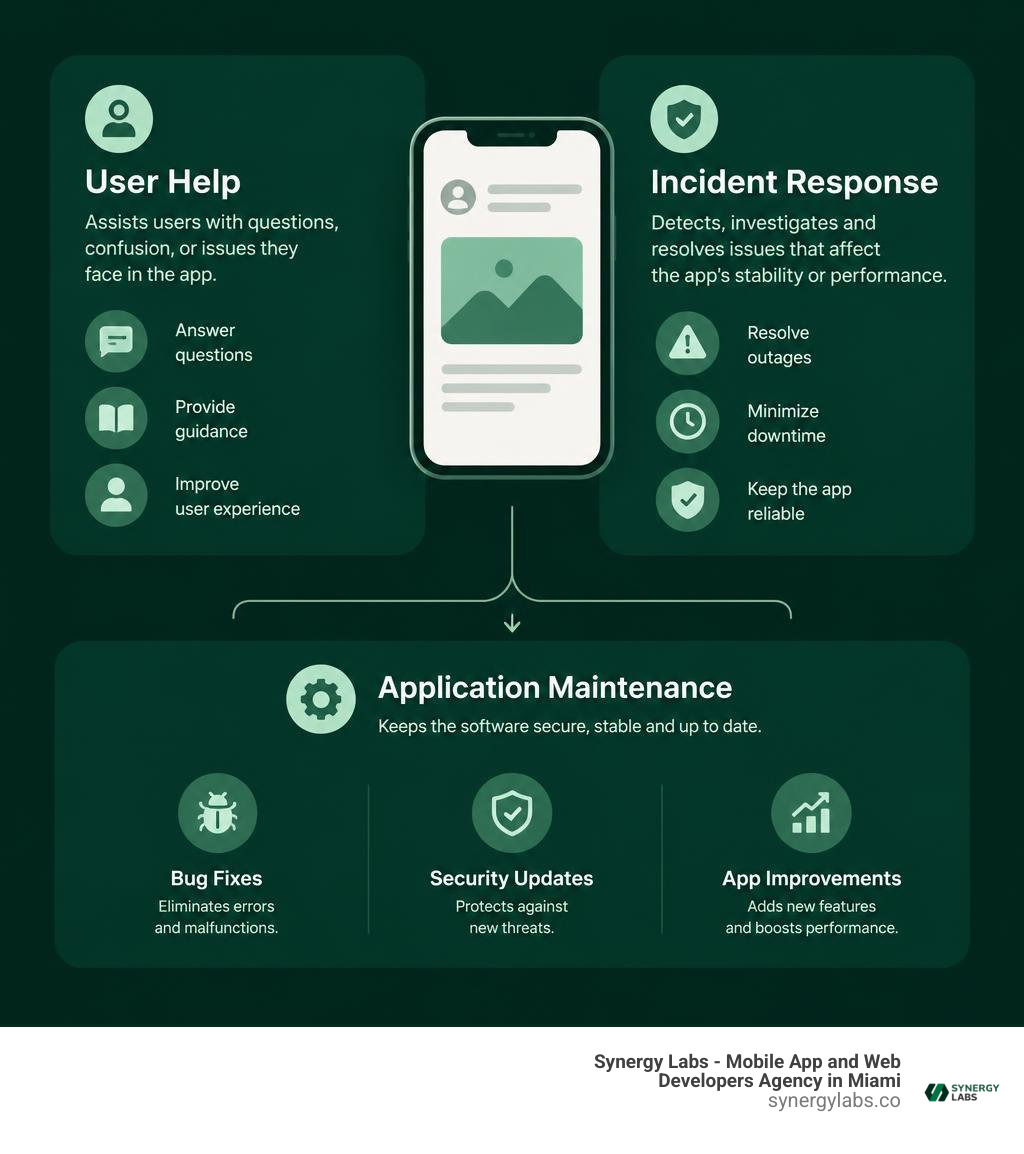
Application support and maintenance keep an app useful after launch, but they do different jobs. Support helps users when something goes wrong. Maintenance fixes and improves the software itself, from security updates to performance work. A reliable app needs both.
For a growing product, that means fewer issues left unresolved and a clearer plan for updates. As director of product at Synergy Labs, I'll break down the roles and what to look for in ongoing support.
Quick application support and maintenance terms:
- App maintenance services
- App maintenance costs
- App security patch maintenance
Understanding Application Support and Maintenance: Core Differences and Synergy
Launching an application feels like crossing a marathon finish line, but in the software world, it is actually just the end of the warm-up. The moment real users start tapping buttons, submitting forms, and testing edge cases you never dreamed existed, your software enters its operational life cycle.
Many business leaders use the phrases "support" and "maintenance" interchangeably. However, conflating the two often leads to operational blind spots, frustrated users, and surprise budget overruns. While both functions share the common goal of keeping your software reliable, their day-to-day focus, execution teams, and technical objectives are distinct. To protect your digital investment, you need comprehensive app maintenance services paired alongside proactive user-facing assistance.
Application Support: User-Centric Problem Solving
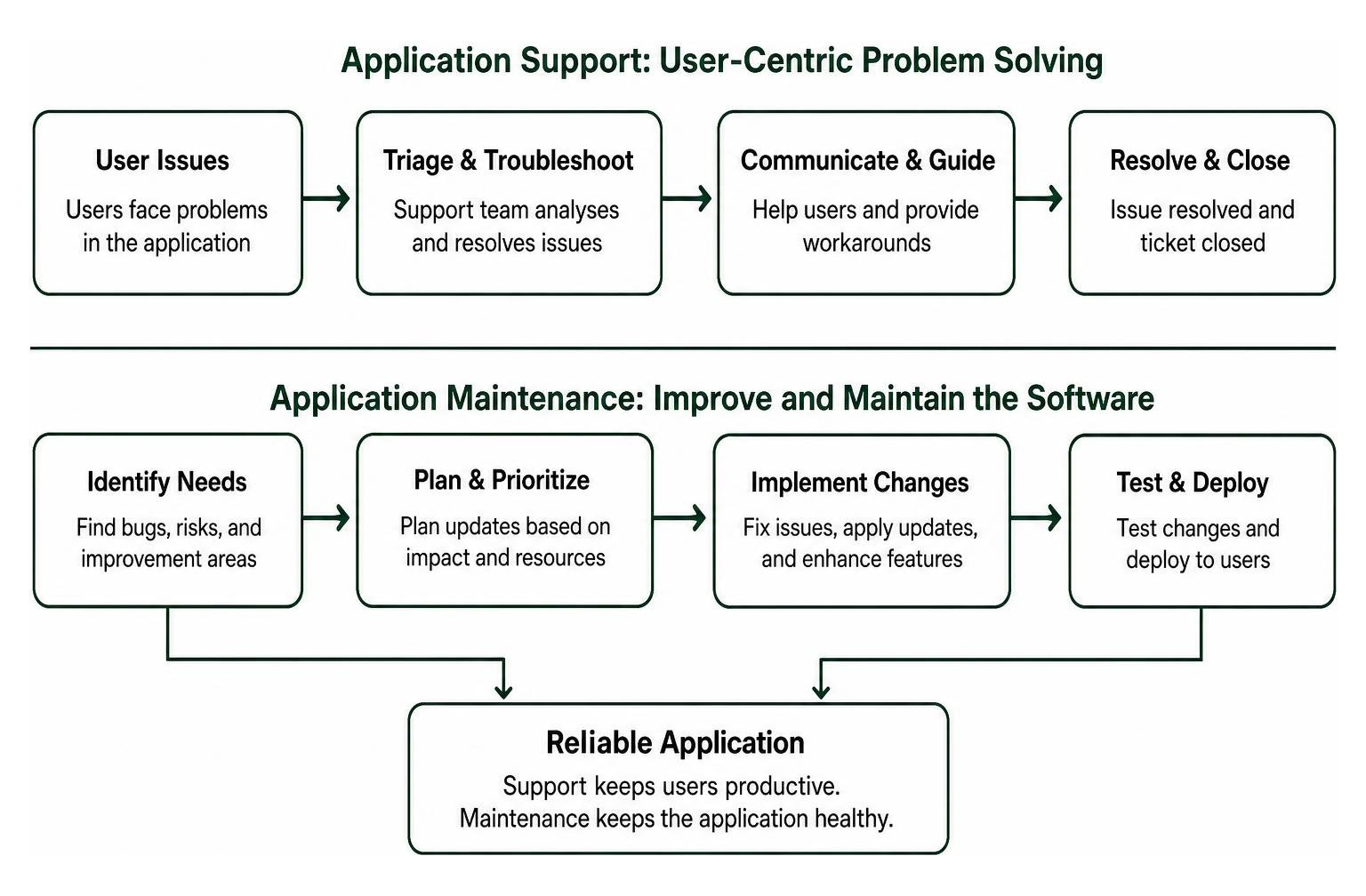
Application support is the front line of your product operations. Its primary purpose is user-centric problem solving: ensuring that your customers, employees, or enterprise clients can accomplish their tasks without friction. When a user cannot reset their password, runs into an unexpected checkout error, or experiences a glitch during onboarding, the application support team steps in to triage, troubleshoot, and guide them to a resolution.
Support specialists focus heavily on incident management, user communication, and user experience (UX) feedback collection. They do not necessarily rewrite the software's underlying source code every afternoon; instead, they reproduce reported bugs, identify operational workarounds, verify system permissions, and categorize tickets based on business impact.
In major tech hubs like New York City, public-sector and enterprise initiatives place immense value on this discipline, as seen in the foundational operational duties outlined in the career requirements for an Application Support Specialist. When done right, dedicated support provides faster answers: high-performing teams maintain a sub-40-second response time on 90% of urgent user inquiries, directly driving customer retention and preserving brand trust.
Application Maintenance: System-Centric Evolution
If application support is the roadside assistance that helps a driver change a flat tire, application maintenance is the mechanic in the garage fine-tuning the engine, inspecting the brakes, and upgrading the transmission. Application maintenance is system-centric and engineering-driven. Its goal is to protect code health, preserve backend stability, and evolve the product over time.
Software is not a static physical asset; it degrades due to code rot, third-party dependency updates, and shifting operating system requirements. Maintenance engineers handle tasks such as:
- Proactive bug fixing and resolving underlying code defects identified by the support desk
- Routine app security patch maintenance to protect against emerging vulnerabilities
- Database query optimization and index defragmentation to eliminate latency spikes
- Code refactoring to eliminate technical debt and ensure scalable architectural growth
- Ongoing compliance management to satisfy evolving privacy frameworks like HIPAA, GDPR, or PCI-DSS
By investing in continuous maintenance, businesses avoid catastrophic technical debt. Mature DevOps and engineering practices can deliver hot-fix deployments in under 8 hours and minor application upgrades in less than a week, keeping digital products competitive and resilient.
The Four Tiers of Support: From Self-Service to Deep Engineering
To manage operational workloads efficiently without burning out senior software architects on simple password resets, modern engineering organizations structure their post-launch operations into a tiered hierarchy.
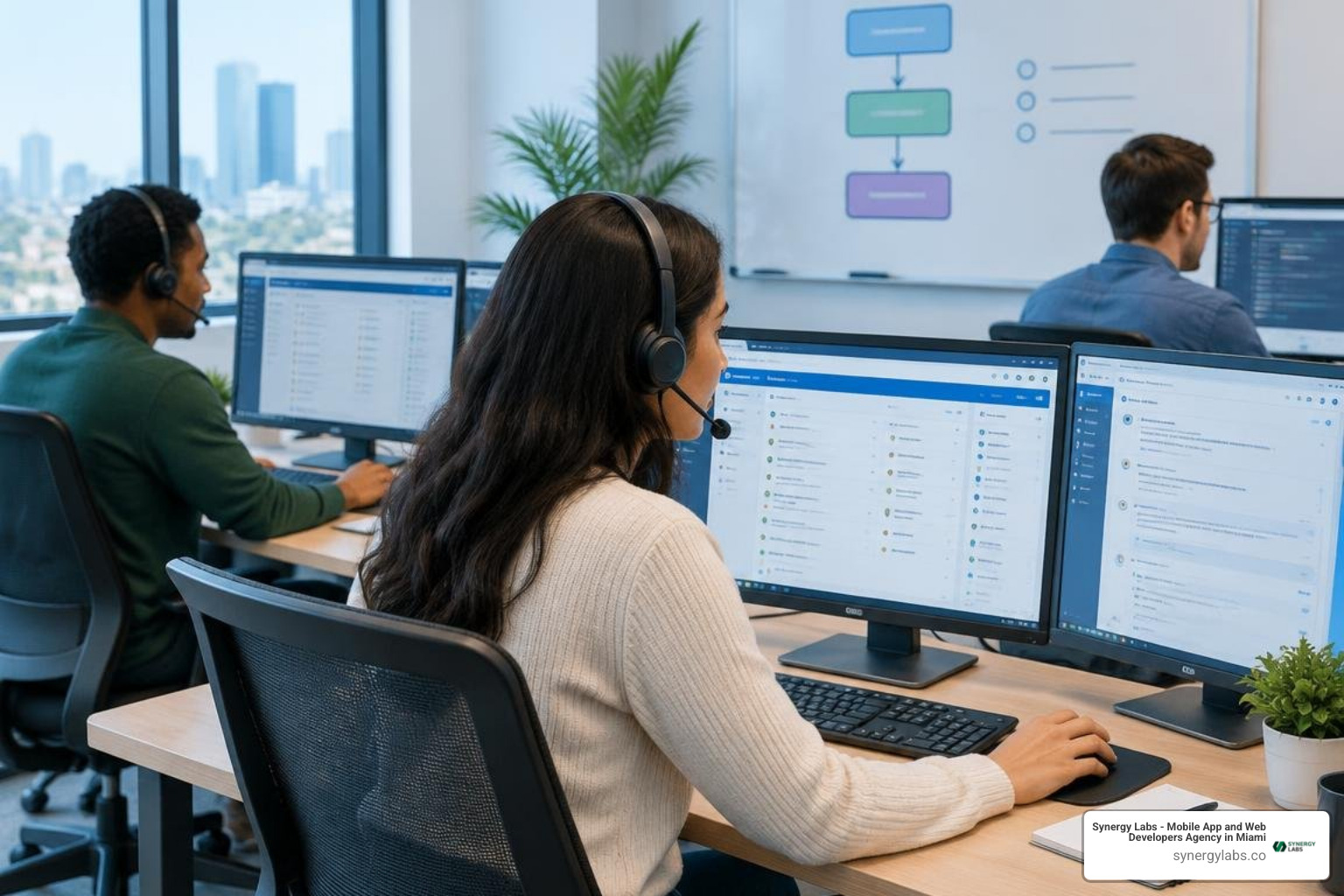
This structure ensures that incoming issues are triaged immediately, resolved at the lowest possible cost tier, and escalated only when deep engineering intervention is strictly necessary.
Structuring Application Support and Maintenance Tier by Tier (L0 to L3)
The standard framework divides responsibilities across four distinct levels:
- Level 0 (L0) – Automated Self-Service: L0 empowers end users to resolve their own problems before creating an administrative ticket. This tier includes searchable knowledge bases, step-by-step onboarding walkthroughs, dynamic FAQs, and interactive AI chatbots. Implementing proactive L0 resources can deflect incoming service desk requests by up to 60%, drastically cutting down operational expenses while giving users instantaneous answers.
- Level 1 (L1) – Basic Triage and Helpdesk: L1 engineers handle first-contact customer inquiries. They collect diagnostic logs, verify account permissions, troubleshoot basic user errors, and resolve standard configuration issues, often completing triage in under 10 minutes. If an issue points to a deeper system bug, the L1 representative documents the reproduction steps and escalates the ticket.
- Level 2 (L2) – Technical and Environment Administration: L2 specialists possess deeper platform knowledge. They dive into server logs, monitor cloud infrastructure, manage integrations, execute database queries, and perform root-cause analyses. Severe non-code incidents escalated to L2 are typically diagnosed and remediated in under 8 hours.
- Level 3 (L3) – Deep Engineering and Code Refactoring: When an incident stems from a software defect, database deadlock, or architectural limitation, it reaches L3. This tier consists of senior software developers and architects who write custom code, refactor broken endpoints, patch security flaws, and manage complex mobile app backend development. L3 teams ensure permanent fixes are tested and deployed safely through automated build pipelines.
Modern Tools, DevOps, and AI in Post-Launch Management
Managing modern digital products across distributed cloud environments requires more than a shared email inbox and good intentions. High-availability operations rely on advanced observability stacks, automated deployment pipelines, and intelligent diagnostics.
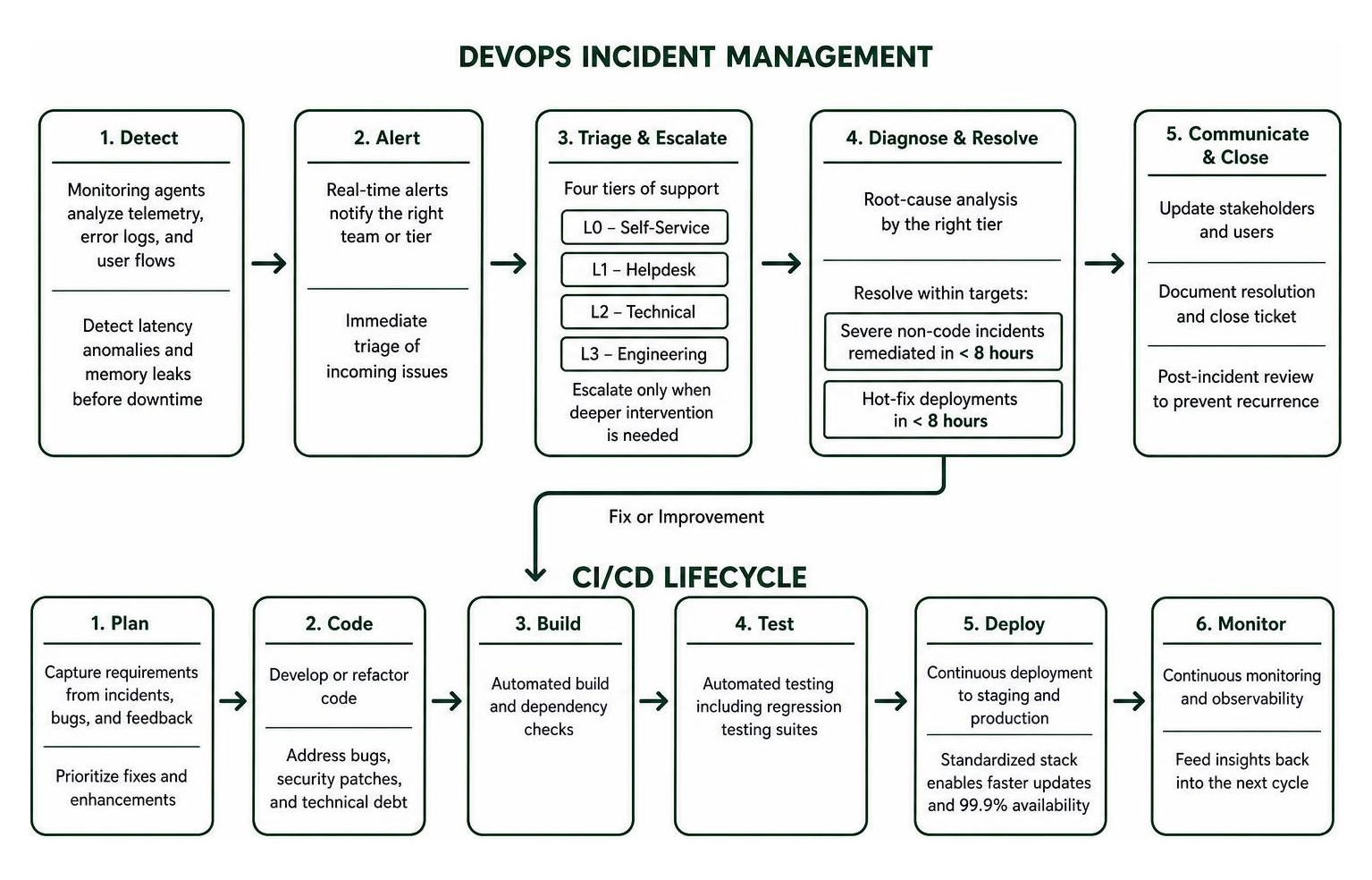
By partnering with an experienced devops app maintenance agency, organizations can implement continuous integration and continuous deployment (CI/CD) pipelines alongside automated regression testing suites. Standardizing your modern mobile app tech stack enables engineering teams to roll out updates up to 40% faster while maintaining a system availability rate of 99.9% for mission-critical workloads.
Furthermore, artificial intelligence and predictive monitoring tools have transformed software operations from reactive firefighting into proactive prevention. Modern monitoring agents continuously analyze telemetry, error logs, and user flows to detect latency anomalies and memory leaks before they result in downtime.
Key Performance Metrics for Application Support and Maintenance
To evaluate whether your post-launch operational strategy is delivering real business value, track standardized Service Level Agreements (SLAs) and operational Key Performance Indicators (KPIs):
- First Response Time (FRT): The elapsed time between a user submitting an issue and receiving an initial human or contextual response. World-class support teams maintain an FRT under 40 seconds on urgent direct channels.
- Mean Time to Resolution (MTTR): The average duration required to troubleshoot, fix, and verify an operational incident. Proactive monitoring helps organizations improve MTTR by 30% or more.
- System Availability and Uptime: The percentage of time that applications remain fully functional and accessible to users, with enterprise-grade standards requiring at least 99.9% availability.
- Hot-Fix Deployment Velocity: The time required to write, test, and ship an emergency patch, with optimized teams delivering code fixes in under 8 to 24 hours.
- User Satisfaction (CSAT): Direct feedback collected after resolving tickets, where mature software teams consistently target greater than 97% user satisfaction.
Maintaining high marks across these operational KPIs requires skilled talent. Demand for these skill sets remains exceptionally high across growing technology centers, as reflected in the hiring velocity and competitive market trends for application support roles throughout major metropolitan areas.
Evaluating Costs, Pricing Models, and Outsourcing Advantages
Budgeting for ongoing software management is a vital aspect of digital product governance. Many organizations suffer from post-launch shock when they realize that building an application is only part of the financial investment. A reliable rule of thumb is to budget 15% to 25% of your initial development cost annually for routine support, maintenance, and cloud infrastructure management.

When establishing a long-term partnership for ongoing software care, businesses typically choose among four primary pricing structures:
- Per-Ticket Pricing: You pay a set fee for each logged and resolved incident. This model works best for stable, mature applications with predictable, low-volume L1 and L2 user inquiries.
- Fixed Monthly Retainer: A predictable monthly investment that secures dedicated engineering capacity for continuous system health checks, security patch rollouts, database optimization, and guaranteed SLA response windows.
- Time and Materials (T&M) with a Cap: You pay for actual engineering hours spent on custom code updates, feature enhancements, and system evolution, constrained by a pre-agreed monthly maximum to ensure budget control.
- Hybrid Support Model: A blended approach combining a fixed monthly retainer for baseline L1–L3 monitoring and maintenance with a flexible bucket of hours dedicated to ongoing product roadmap evolution.
Choosing the right engagement model allows enterprises to reduce annual support overhead by up to 25% and achieve up to a 42% reduction in cloud total cost of ownership (TCO). For a comprehensive breakdown of long-term software budgeting, consult our enterprise app development guide for 2026.
Industry-Specific Needs and Enterprise Scalability
Different industries face distinct technical, operational, and regulatory demands when maintaining their software ecosystems:
- Healthcare: Applications handling electronic protected health information (ePHI) require rigorous HIPAA compliance monitoring, encrypted audit logging, zero-downtime data migrations, and continuous vulnerability scanning.
- Financial Services and FinTech: Platforms processing payments or real-time transactions must adhere to PCI-DSS standards, maintain sub-second transaction processing speeds, and guarantee 99.99% system availability to prevent financial loss.
- E-Commerce and Retail: Consumer-facing digital storefronts experience massive, seasonal traffic spikes. These platforms require elastic cloud auto-scaling, dynamic caching layers, and responsive L1 support to safeguard checkout funnels.
- Enterprise Mobility: Large organizations deploying internal or customer-facing mobile platforms require cross-platform OS compatibility, regular updates for new iOS and Android releases, and scalable backend architectures.
To explore how large organizations navigate high user concurrency and multi-system integration challenges, review our insights on enterprise mobile app development scaling solutions for large organizations and discover practical strategies in our guide on how to successfully scale your mobile app development.
Frequently Asked Questions About Software Management
What is the primary difference between application support and maintenance?
Application support focuses outward on the end user by troubleshooting immediate issues, answering technical questions, and resolving day-to-day incidents to keep users productive. Application maintenance focuses inward on the software itself by refactoring code, applying security patches, optimizing databases, updating frameworks, and implementing architectural improvements to ensure long-term stability and performance.
How do AI and automation lower ongoing support costs?
AI and automation reduce support overhead by deflecting routine tickets through intelligent self-service knowledge bases and conversational AI agents. On the backend, automated monitoring tools continuously scan system telemetry to detect anomalies, optimize cloud resources, and auto-heal infrastructure bottlenecks before they cause downtime. These automated workflows reduce manual maintenance hours by up to 30%.
Which pricing model is best for post-launch maintenance?
The ideal pricing model depends on your product's maturity and release cadence. For stable applications with low ticket volumes, a per-ticket or basic monthly retainer model is cost-effective. For actively growing platforms that require continuous security updates, code refactoring, and iterative feature rollouts, a hybrid model—combining a fixed monthly SLA retainer with a flexible Time and Materials allocation—provides predictable budgeting alongside on-demand engineering capacity.
Protect and Evolve Your Digital Products with Synergy Labs
Building a great application is an achievement, but keeping it secure, performant, and aligned with user expectations is what transforms a product launch into a lasting business success. Navigating the balance between end-user troubleshooting and backend code maintenance does not require an army of expensive, full-time in-house engineers—it simply requires the right technical partner.
At Synergy Labs, we eliminate the headache of post-launch software management. We provide direct access to senior technical talent through a high-efficiency delivery model that pairs an in-shore CTO with an elite offshore development team. This unique structure ensures clear, strategic communication alongside cost-effective engineering execution.
We protect your capital and eliminate financial surprises by working with transparent, fixed-budget agreements and milestone-based payments, ensuring your maintenance and feature enhancement projects are completed on time, within scope, and on budget. Whether you need 24/7 proactive monitoring, rapid security patching, or scalable cloud optimization, we keep your digital products performing at their best.
Ready to secure the future of your software? Explore our expert app development and maintenance services and let Synergy Labs protect, maintain, and scale your digital applications today.