
How to Market a Mobile App Launch

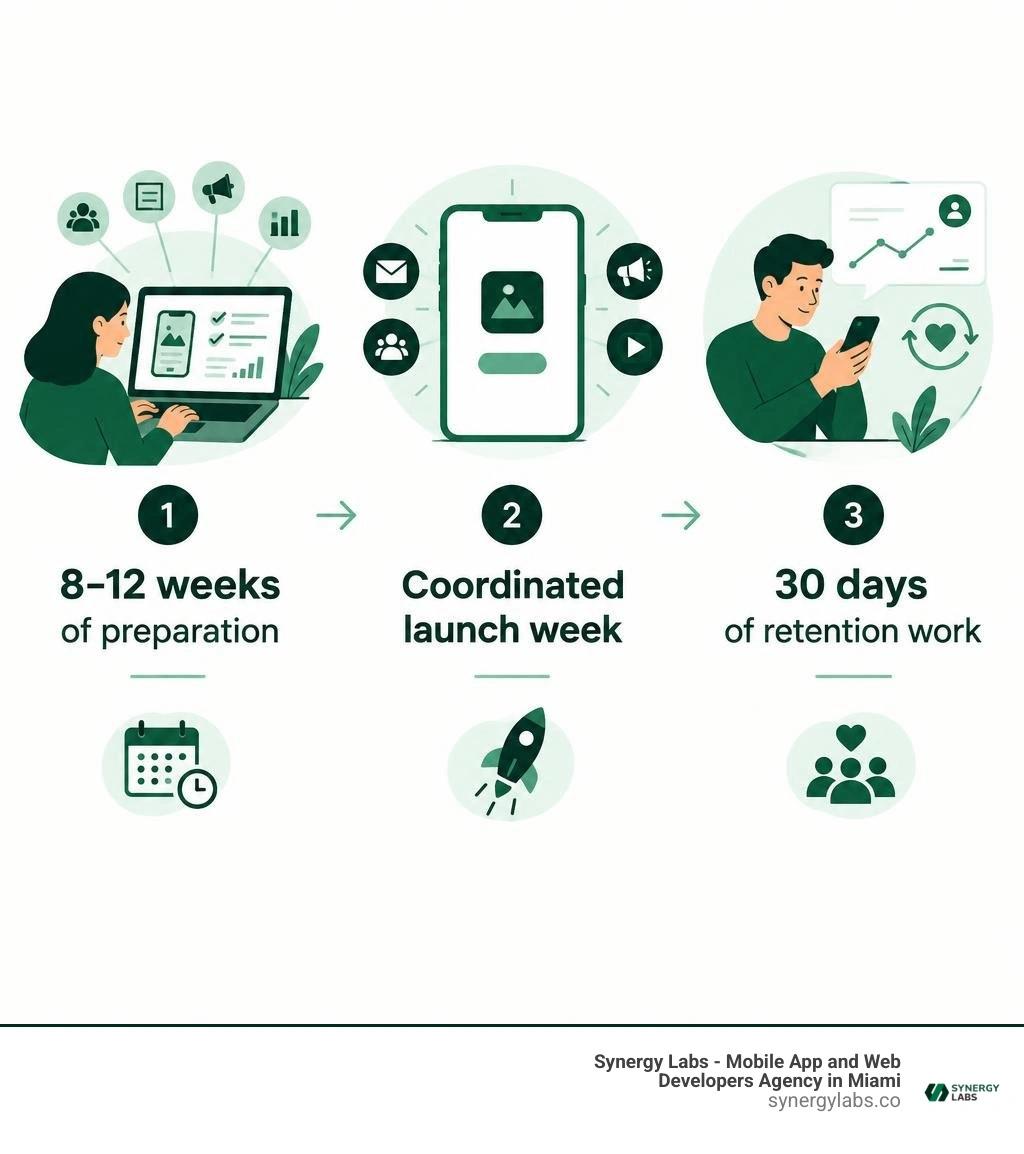
Start marketing before your app goes live. Build a waitlist and test the app with early users. Prepare your app store listing, launch content, and tracking. Then coordinate your email, creator posts, community outreach, and ads around release day. After launch, focus on whether people use the app and come back, not just how many install it.
In 2026, a store listing alone is unlikely to get a new app noticed. A strong launch gives people a reason to try it, makes it easy to find, and helps you learn what to improve.
I'm the director of product at Synergy Labs, and I'll walk you through that plan from pre-launch to lasting growth.
Terms related to mobile app launch marketing:
- app development success stories
- app development trends 2023
- custom mobile app design
The 30-60-90 Day Pre-Launch Foundation
Every year, roughly 1.5 million new apps enter the App Store and Google Play combined. Most of them launch into total obscurity because founders make one fatal assumption: they believe that building a stellar product is 90% of the battle. In reality, building without an audience is like constructing a world-class theme park in the middle of the desert without building any roads to get there.
Data shows that apps with a structured pre-launch phase achieve 3 to 5 times more first-week installs than those that launch cold. Transforming an initial concept into a thriving product requires mapping out your distribution channels alongside your technical milestones. When steering a project from idea to launch, your marketing calendar should begin at least 8 to 12 weeks before your targeted release date.
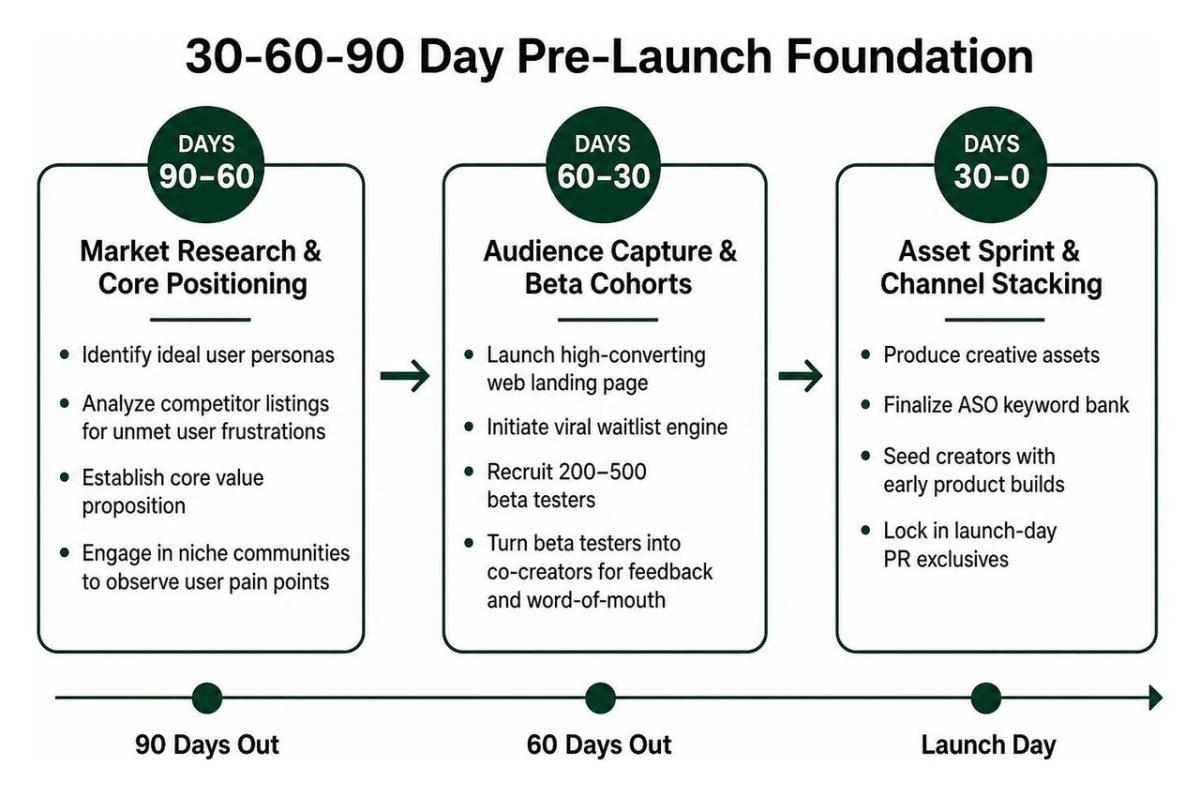
A comprehensive pre-launch framework breaks down into three distinct phases:
- Days 90 to 60 (Market Research & Core Positioning): Identify your ideal user personas, analyze competitor listings for unmet user frustrations, and establish your core value proposition. Engage in niche subreddits, Discord servers, and industry communities to observe how prospective users describe their pain points.
- Days 60 to 30 (Audience Capture & Beta Cohorts): Launch a high-converting web landing page, initiate a viral waitlist engine, and recruit a dedicated cohort of 200 to 500 beta testers. A structured Pre-Launch Playbook for Mobile Apps turns your beta testers into co-creators who supply critical user feedback and early word-of-mouth momentum.
- Days 30 to 0 (Asset Sprint & Channel Stacking): Produce creative assets, finalize App Store Optimization (ASO) keyword banks, seed creators with early product builds, and lock in launch-day PR exclusives.
Designing a Pre-Launch Funnel for Mobile App Launch Marketing
A pre-launch landing page serves as your central conversion hub long before your store listings go live. The goal is straightforward: turn curious visitors into motivated evangelists who will download your app the second it hits the store.
To maximize signups, focus on these landing page essentials:
- Outcome-Driven Hero Copy: State the primary user benefit in a single sentence rather than listing vague features. Mastering clear messaging for landing pages dramatically lifts signup conversion rates.
- Product Teasers: Embed a 15 to 30-second product demo video or high-fidelity interactive preview so visitors can visualize the core user experience.
- Built-In Referral Loops: Implement milestone-based incentives. When a user joins the waitlist, give them a unique referral link. Moving up the queue or unlocking exclusive launch-day perks for referring 3 to 5 friends turns standard lead capture into organic viral growth.
A well-architected referral waitlist can generate 30% to 40% of its total volume from referrals alone. With an average 30% to 50% conversion rate from waitlist subscriber to day-one download, building a 5,000 to 20,000-person pre-launch list reliably yields 1,500 to 10,000 day-one installs.
Keep your waitlist warm by establishing an automated email cadence:
- Day -21: A welcome note detailing the founder journey and core problem being solved.
- Day -14: An exclusive sneak peek at key UI screens or behind-the-scenes engineering.
- Day -7: Early-access invitations for the top 10% of referral leaderboard participants.
- Day -1: A final countdown reminder instructing subscribers to keep their push notifications enabled.
- Day 0: The official release announcement containing platform-specific download links.
Seeding UGC and Creator Partnerships Early
Content scarcity is the single biggest reason mobile app launches lose momentum after day two. If you wait until launch morning to produce video assets, your marketing engine will stall out almost immediately.

Begin building an internal library of 40 to 60 user-generated content (UGC) assets at least 6 to 8 weeks before launch. Recruit 15 to 25 micro-creators (those with 5,000 to 50,000 highly engaged followers) across your primary audience niches. Micro-creators often deliver higher engagement and deeper community trust than broad-reach celebrity influencers, all while keeping production costs manageable.
Provide these creators with early TestFlight or Google Play Beta builds, and let them craft authentic problem-and-solution hooks rather than stiff, rehearsed corporate scripts. Study modern breakout launches: Cal AI's seeded cohort of 20 creators drove over 2 million impressions within their initial 72-hour launch window by flooding social feeds with authentic reactions. Incorporating tested viral marketing strategies helps ensure your creative assets trigger curiosity and sharing across TikTok, Instagram Reels, and YouTube Shorts from day one.
The Core Pillars of Mobile App Launch Marketing
A memorable launch is an engineered system, not a random stroke of luck. Modern mobile discovery relies heavily on intentional store placement, synchronized social channels, and precise cross-platform attribution.
Industry data confirms that 65% to 70% of all mobile app downloads originate directly from searches within the app stores. If your app is invisible for high-intent search queries, even the flashiest PR campaign will fail to produce long-term organic growth. Startups that combine organic social storytelling with targeted discovery mechanisms achieve up to 50% faster user acquisition than those relying exclusively on traditional paid advertising. Reviewing a dedicated social media launch guide for mobile apps will help you align your brand narrative across platforms before you start driving traffic.
App Store Optimization (ASO) and Ratings Sprint Preparation
App Store Optimization is your permanent organic acquisition engine. Setting up your ASO metadata must happen weeks before your binaries clear app review.
Key ASO execution points include:
- App Title & Subtitle: Place your highest-volume, highest-relevance keyword in your title alongside your brand name (e.g., "Brand: Habit Tracker"). The subtitle should reinforce secondary intent keywords.
- iOS Keyword Field: Maximize all 100 characters in the backend keyword field. Separate terms with single commas, avoid spaces, skip duplicate words, and exclude category names that Apple indexes automatically.
- Visual Conversion Assets: Design your first three screenshots to function as a cohesive visual storyboard. Use bold, contrasting captions across the top third of each image to highlight your core value proposition within seconds of a search impression.
- Custom Product Pages (CPPs): Build tailored App Store product pages that match specific ad campaigns or influencer segments. Aligning your ad visuals directly with your store listing can boost conversion rates by 15% to 25%.
- The Launch-Week Ratings Sprint: Apps with fewer than five ratings display no aggregate star score, and listings below 4.0 stars suffer massive conversion penalties. Prepare an early ratings sprint by prompting your pre-launch beta users to leave candid reviews on launch day. Implementing targeted in-app review prompts immediately after a user experiences an early "aha!" moment helps you collect 50+ positive ratings in your opening week, setting the stage for topping the App Store in 2026.
Coordinating Multi-Channel Attribution in Mobile App Launch Marketing
Modern mobile privacy frameworks require a bulletproof measurement infrastructure. You cannot optimize what you cannot measure, and running multi-channel campaigns without clear attribution burns capital fast.
Integrate a dedicated Mobile Measurement Partner (MMP) such as Adjust or AppsFlyer early in your technical build. An MMP unifies acquisition data across paid social, search ads, organic referrals, and creator links into a single, privacy-compliant dashboard.
Implement deferred deep linking across every external campaign. If an influencer promotes a specific workout routine on TikTok, tapping their link should route new users through the App Store and open that exact workout routine immediately upon first app launch. Eliminating onboarding friction directly increases install-to-registration conversion rates.
Finally, schedule your public launch events—including community rollouts and Product Hunt campaigns—for a Tuesday, Wednesday, or Thursday at 12:01 AM Pacific Time. Midweek releases capture peak engagement, give your team full engineering support during working hours, and bypass the weekend traffic drops typical of productivity, fintech, and utility categories.
Executing Launch Week: Channel Stacking and Paid Acquisition
Channel stacking is the practice of coordinating all your marketing initiatives—waitlist emails, creator posts, paid ad campaigns, PR announcements, and community posts—into an intensive 48 to 72-hour window.
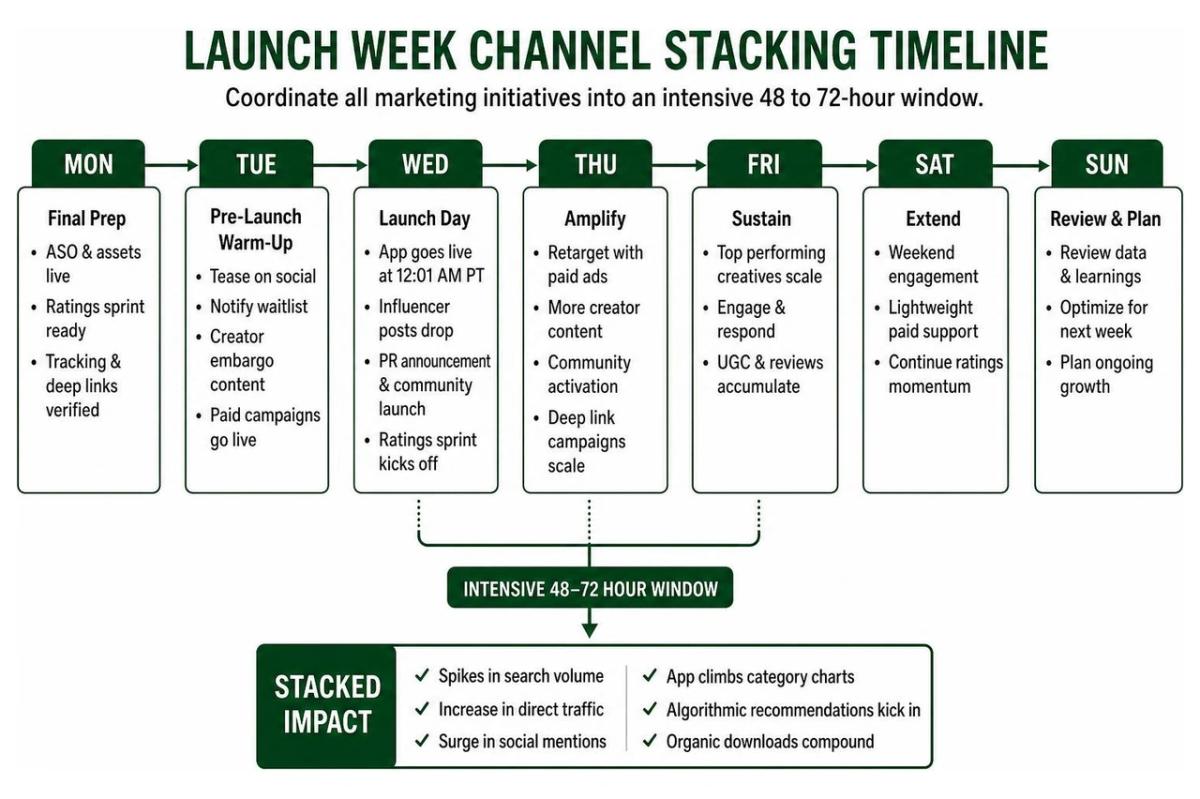
When algorithms across TikTok, Meta, Google, and Apple detect simultaneous spikes in search volume, direct traffic, and social mentions, your app moves up category charts. Chart movement sparks algorithmic recommendations, creating an organic flywheel of compounding downloads. Executing this playbook cleanly requires a disciplined rapid app launch execution plan where every team member knows their daily deliverables.
Paid Media Budget Allocation and Creative Testing
You do not need a massive enterprise budget to execute a high-converting launch. An agile budget of $5,000 to $15,000 allocated over your first 7 to 10 days provides enough data to test channels and establish your baseline Cost Per Install (CPI).
Allocate your launch-week paid media spend across these core channels:
- Apple Search Ads (30% to 40% of Budget): Capture high-intent users actively searching for your primary keywords and direct competitor terms. ASA delivers the highest post-install retention rates across the iOS ecosystem.
- TikTok Spark Ads (25% to 35% of Budget): Boost high-performing organic UGC creator assets directly from native creator handles. Short-form video ads routinely generate 1.5 to 2 times higher click-through rates (CTR) than static image banners.
- Meta Advantage+ App Campaigns (20% to 30% of Budget): Leverage automated machine learning to find high-value target audiences across Instagram Reels and Facebook feeds. Meta's automated targeting models often cut early CPIs by 10% to 20% once campaigns exit their learning phases.
- Google App Campaigns (10% to 15% of Budget): Scale volume across YouTube, Google Search, and Google Play, using Target CPI bidding to prevent runaway ad spend.
Establish strict daily creative testing thresholds. If an ad creative fails to generate clicks or installs within its first $50 to $100 of spend, pause it immediately. Reallocate budget toward your top-performing hooks, emotional angles, and problem-solving video variations.
Organic Amplification and Viral Mechanics
Paid ads provide immediate distribution, but organic viral loops generate lasting brand equity. Weaving organic viral mechanics into your core product architecture transforms every new user into a potential growth channel.
Study the psychological mechanisms behind viral product loops, such as those broken down in our analysis of the psychology of viral app design. High-growth mobile apps provide users with natural social incentives to invite friends, share achievements, or collaborate inside the platform.
Complement your in-app loops with targeted media outreach:
- Curate a Focused Press List: Build a list of 30 to 50 journalists, tech columnists, and niche bloggers who actively cover your category.
- Lead with the Narrative, Not the Feature List: Pitch a timely cultural trend, a surprising market shift, or a founder journey rather than simply stating that a new app exists.
- Distribute a Frictionless Press Kit: Host a downloadable press folder containing high-resolution app mockups, founders' headshots, product demo clips, and a one-page fact sheet with key company milestones.
Post-Launch Growth: Turning Momentum Into Long-Term Retention
A massive launch-day download spike means nothing if your users abandon your app within 24 hours. Retention is the true foundation of sustainable mobile growth.

Shift your focus toward these core retention metrics immediately after launch week:
- Day-1 Retention (D1): Measures the percentage of users who return the day after downloading. D1 directly reflects the quality of your first-time user experience and onboarding flow.
- Day-7 Retention (D7): Indicates whether new users are finding lasting value in your core product features.
- Activation Rate: The percentage of users who complete your primary value milestone (such as logging their first workout, linking a bank account, or sending their first message) during their initial session.
Streamline your onboarding flow by removing unnecessary form fields, offering one-tap social logins, and guiding users directly to their first core action. Deploy contextual in-app messages and automated push notification sequences to re-engage users who drop off during setup. Teaming up with specialized growth marketing services can help you set up these engagement loops and keep your acquisition costs sustainable over time.
Common Launch Pitfalls That Cause Early Churn
Even technically sound apps can struggle if their go-to-market execution misfires. Watch out for these common launch mistakes:
- Single-Channel Dependency: Relying solely on paid ads or a single press mention leaves you vulnerable to sudden platform policy updates or rising ad costs. Build a diversified marketing mix from day one.
- Launching on a Friday or Weekend: Releasing right before the weekend lowers press visibility, slows B2B and utility app engagement, and leaves you with fewer support resources if unexpected server issues arise.
- Ignoring ASO Metadata Until After Release: Treating app store copy as an afterthought limits your organic search visibility during the early window when stores evaluate new app momentum.
- Overpromising and Underdelivering: Setting unrealistic expectations in your ad creatives frustrates early adopters, leading to negative early reviews that permanently harm your conversion rates.
- Stopping Content Production After Launch Week: Halting your social posts and creator partnerships after day seven cuts off top-of-funnel discovery just as the initial buzz begins to fade.
Frequently Asked Questions about Mobile App Launch Marketing
How much budget should be allocated for a mobile app launch?
An effective launch-week marketing budget generally ranges from $5,000 to $15,000 for early-stage startups and consumer apps. This budget provides enough runway to test Apple Search Ads, TikTok Spark Ads, and Meta campaigns while establishing baseline Cost Per Install metrics. For hyper-local or specialized B2B utility apps, founders can launch effectively with $2,000 to $5,000 by leaning heavily on pre-launch community building, organic creator seeding, and micro-influencer outreach.
How many weeks before launch should marketing begin?
Mobile app marketing should begin at least 8 to 12 weeks before your planned App Store and Google Play release date. This window gives you ample time to conduct audience research, test landing page copy, run beta testing cohorts of 200 to 500 users, build an email waitlist of 5,000+ subscribers, and produce an asset library of 40 to 60 UGC videos.
What is the most critical metric during launch week?
While aggregate download volume drives vanity charts, Day-1 retention and core activation rate are the most critical metrics for long-term success. A healthy app should aim for a Day-1 retention rate of 35% to 45% or higher, depending on the category. If your Day-1 retention drops below 20%, pause aggressive paid acquisition immediately to resolve onboarding friction, fix bugs, and refine your core value loop before spending more capital.
Launching Your App into a Scalable Growth Engine
A successful mobile app launch is not a one-time press release—it is a coordinated, multi-channel growth system. When you align audience research, early waitlist mechanics, strategic creator partnerships, robust App Store Optimization, and disciplined paid acquisition, your app enters the store with real momentum instead of launching to an empty room.
Building and launching a top-tier mobile product requires deep technical precision and a sharp go-to-market strategy. At Synergy Labs, we partner with visionary founders and enterprises to take digital products from early architecture all the way to chart-topping store releases. We eliminate agency guesswork through our transparent, fixed-budget model, milestone-based payments, and hands-on technical leadership—pairing an in-shore CTO directly with an elite offshore development team to deliver world-class apps on time and on budget.
Ready to build an app that users love and return to every day? Partner with Synergy Labs for end-to-end app development and launch, and let's turn your product vision into a measurable market success.